Sunday, 27 December 2015

Why I love(d) Happy Endings?

Friends. A show about six friends, three males and  three females, and their 'adventures'. A historical comedy show right? Even if you hadn't watched every episode, you knew about it, you'd watched it, you'd enjoyed it. Even if you didn't know that blonde one's real name (Lisa Kudrow btw), you laughed at what she said because it was funny. Fast forward just under a decade later, an ABC pilot, with so little hope that one of the main character's secured a job on a different show, aired. This particular show, Happy Endings, was about six friends (sound familiar?), two of which were getting married, where the woman left her male counterpart at the altar for a man in rollerblades. This situation led to rift within the group of six and thereby creating a premise of whether these six friends would be able to stay friends with such a... history between two of them. But by the second episode, this show felt like it was dropping this premise for another one. A show about six friends, three males and three females, and their 'adventures'.

Now people were quick to write it off as another 'worse, modern day Friends', but after the show's fairly average pilot, it began to pick up, surprisingly quick and the chemistry between the six main cast members was infectious. And if you know anything about, ensemble comedies (Modern Family, Community, The Office), you know, group chemistry is REALLY IMPORTANT, yet extremely hard to build quickly. But suddenly this group of six friends that we had only known for 10 episodes had inside jokes, recurring gags and were very likeable characters. They felt like a real group of friends, and realism is practically what all pop culture aims for nowadays.

Now not only did this group have great chemistry, but they were propelled by brilliant acting, fantastic writing and jokes that flew at breakneck pace. Yet all they were considered as by those that had heard about the show, was some kind of Friends' knockoff. Now I'd have to blame ABC for this, particularly for poor advertisement, and really poor scheduling. For emphasis, let me tell you the order in which the season 1 episodes aired as opposed to how they were supposed to air: Episode 1, Episode 5, Ep. 9, Ep. 8, 12, 7, 4, 11, 10, 2, 3, 13 and 6. Because screw chronology right? And considering this show has a great sense of continuity, it hurt it even more. But despite that, the show continued to excel even further in its surprise second and third seasons, receiving critical acclaim and creating a cult following, as it crafted the world around the protagonists with recurring characters and lengthened storylines. But then it was cancelled after its third season, due to low viewer ratings, because once again it was just a 'bad Friends' remake' that no one really knew about.

But the reason it's not fair to say that, is because Friends was such a genre defining show, that its influence can honestly be sensed in pretty much all sitcoms since its success. And when I see Happy Endings, Friends does come to mind, but it doesn't remind me of it as much as one would think. Its single-camera format as opposed to Friends' multi-camera one made the show feel more dynamic. It was a lot more fast-paced and a lot more courageous. They went for parodies, their characters were wackier, and to be honest, it worked! Their weird contrasts paid off! And it was great to see that, because it gave it a different, more welcoming atmosphere. You didn't want to have friends like them, because it made you feel like you were a part of them. The show even actively made fun of their copycat naysayers with this scene from the season 2 episode, 'The St. Valentine's Day Maxssacre'.


As a result, I prefer Happy Endings to Friends. Even if it doesn't have a cool episode naming system! And I say that having watched every episode of both shows. Maybe I'm just a hipster, but when I watch Happy Endings, it has such a feel-good factor. So good that I have a playlist for it on YouTube. And pretty much every time I watch a clip of it, I ask myself, "Why the hell was this show cancelled?"

From a media standpoint, the use of editing and lighting in this show has always been outstanding. Mise en scene in the show is brilliant, using positioning, costume and props for comedic advantage frequently. Making use of smart camera angle goes to compliment the great mise en scene changes to reveal things that were previously hidden (usually for a funny effect).

Damn that post was long! Anyway, favourite episodes (there's quite a few): Dave of the Dead, Baby Steps, Secrets and LimosSpooky Endings, The Code War, The St. Valentine's Day Maxssacre, Everybody Loves Grant, The Butterfly Effect Effect, The Kerkovich Way, Boys II Menorah, More Like Stanksgiving, No-Ho-Ho, The Ex Factor, The Marry Prankster, The Straight Dope, Un-sabotagable, Brothas and Sistas

My VERY favourite are in bold! I wanted to include more on that list by the way...

Sunday, 13 December 2015

Sample footage

This is some sample footage (surprise, surprise!) from our filming, acting credits for this post goes to the wonderful Miss Kerry-Ann (et moi). Filming credits go to the talented Mr Gavin Bowyer. Not to brag or anything but I also was the set designer and controlled the lighting. Your're welcome :)

This is our final decision of how to represent the thriller opening that we wanted as we had the correct  amount of lighting which shows the main character and the actions that they are doing. We also decided on the the focusing in and out which gives the effect of someone just waking up to seeing someone but for us it helps because it makes the main character seem distorted. 


At first we had thought that this would be the perfect lighting  for the scene however it was too bright and had not created the effect that we had wanted to aim for.


We also had thought that this would be a good place to film our scene however there was minimal light so it was hard to film and although we had found out that shining a touch on the lights created a twinkling effect which would be great for our thriller opening it was still hard to film. We also thought that it would suit a horror opening more than a thriller opening. 

Thursday, 10 December 2015

Animatic


This is our first iteration of the our animatic from the first storyboard. As you can see, a lot of the shots are drawn out, in order to lengthen the opening, we also included some random transitional shots, to set the atmosphere and to insert titles cleverly. Animated by Mr Gavin Bowyer.

Tuesday, 8 December 2015

Storyboard

This is the storyboard for my group project. In coming up with this idea we brainstormed whether to use abstract shots or attempt to fill up time with transitional shots. We eventually settled on filler shots of cards and glass cups as it adds to the atmosphere and was a more sophisticated way of using time, especially in the genre of a spy thriller. The choice to use slow motion also stemmed from the idea of making a spy thriller look 'cool'. The art was made by the one and only Gavin Bowyer.


Thursday, 3 December 2015

1 minute reshoot of thriller

For the preparation and research of our thriller, we recreated the first minute of the critically and commercially successful thriller. 


Could you guess what film it was before the end? No? Not surprising. We didn't exactly have a pendulum, but we made the most out of what we had.


Comparing this to the actual SE7EN opening, our version is a fairly accurate depiction, in terms of narrative, audio and camera angles. The lighting was also slightly higher key in our version, making it lose it's mysterious edge. Lighting that is too bright in a thriller does not create a sinister or mysterious atmosphere which is the main goal of a thriller. Being able to learn from this mistake will ensure that the lighting in our final product will be sinister enough to create the atmosphere of a thriller. Our remake however made effective use of sound. Not only did using the ticking clock emphasise the passing of time, it also sounded quite creepy, causing the viewer to feel fear. This did teach us that sometimes minimal sound like quiet background music and a clock ticking can form a very eerie environment, that would be very useful in our final product. The editing in our remake is noticeably little making it very slow-paced, to match the SE7EN which uses the slow pace to elongate the ominous effect of the shots and clock ticking to ensure the audience is pushed out of their comfort zone. We could use this combo of eerie sound and slow-paced editing in our final thriller opening as it has the effect of making the audience feeling awkward, which is one of our intentions for our thriller.

Saturday, 28 November 2015

Costume and prop list and shot list

A fairly simple presentation, detailing the various costumes and props that we'll be using for our thriller opening. It also contains the different shots we'll be taking advantage of and why we're using them.


Monday, 23 November 2015

Treatment

It opens on an extreme close-up of a man (John) in a suit and red tie, showing only his chest. The camera pans out wider with the credits fading in and out around him, eventually revealing he is at a poker table with two men in suits and a black tie either side of him with John in a spotlight.  The panning stops and the shot is left on the wide shot of the three men at the table. We then see a few close up shots of the dealer shuffling and dealing cards, someone taking a drink and someone pushing in some chips. It then cuts to a close up of John, he lays two aces down on the table, it then cuts back to the close up of John as his poker face slowly curves into a smirk. “Looks like the last draw,” John then says wryly and then as he stands and draws a gun it returns to a wide shot of John drawing his gun in slow motion and the screen goes black. Then, when he fires the screen lights up because of the flash. The camera will aim the light source at his gun instead of John. There's a slow motion shot of him shooting a guy then it fades to black, then he changes his pose and same again for each guy but the each one is not as slow as the last then cut to title screen. 

John Reed: Diamond Hand


Wednesday, 18 November 2015

Target Audience Profile

This is the target audience profile for my media project as I'm sure you are clearly aware of by now. the target audience profile simply outlines the male and female concepts of the sort of people we predict will watch our film. Hopefully specific enough to the point where you begin to worry whether you're just like everyone else.


Tuesday, 17 November 2015

The difference between a horror and a thriller

Horrors and thrillers. Two movie genres that can be alarmingly alike, yet are entirely different. The confusion between these two genres often stems from, fear-inducing thrillers being mistaken for horror due to the fright produced from it. However, some thrillers do intend to scare the audience, it is not the main objective of a thriller. Here are the differences between a horror film and a thriller film:

INTENT

In plain terms, the purpose of a horror film alone, is to scare, meanwhile for a thriller, it isn't. A thriller usually aims to intrigue the audience with mystery, which when dark enough, can look like a horror. And this is why the two genres are sometimes mixed up. One thing to note is that thrillers are usually more story-driven than horrors.

JUMPSCARES
Once again, thrillers main focus isn't to scare the audience so features such as jumpscares would not usually appear. Horror films on the other hand frequently make use of this technique to keep the viewers on the edge of their seats.

NO HOPE
Horror films don't usually have a surprising story. Everyone usually just dies. And that is why they are different from thrillers. This lack of hope in horror films is quite the opposite in thrillers where the mystery usually continues to give the protagonists hope.

FOCUSED ON DEATH
Another difference of horrors from thrillers is its focus on death. This the reason death is nearly always included in a horror, usually because most horrors make use of death to keep the audience in the belief there is danger.

Monday, 16 November 2015

Media Proposal

This. This is it. The Proposal (No, not the film, besides, it's not even a thriller). This, is my media proposal. Containing the concept, story and many more for my group and I's media project! However, lest we not hold thou back from thine brilliant proposal, thouest you seeth it for thineselves (Don't judge me for not being able to speak Old English. I'm Nigerian.)


Amazing, right?

Tuesday, 3 November 2015

Planning Sheet

This presentation contains the brainstorm for our first idea for our thriller opening, before we cut it down to streamline it and make it easier to follow narratively. You're welcome to marvel at our naively optimistic, unnecessarily large-scale ideas, for our 2 minute thriller opening.

Monday, 26 October 2015

Preliminary Task

Ah, the preliminary task. This was the first chance we had at filming and practising movie techniques such as the 180 degree rule, match on action and reverse angle shots. Enjoy.


The preliminary task was our first shot at camerawork. For the first time we couldn't get proper lighting and so we had to film in areas that were well lit already. This made it impossible to film some shots we had intended and so we had to change our preliminary task idea. Another difficulty we encountered was the annoyance of ambient sound. Since we did not plan the filming, we could not control the external variables which would cause a lot of sound when filming, rendering diegetic sound from the actual filming useless. 

When we film next time we will ensure to schedule the correct place for a time tat will be appropriate sound and lighting wise. This will make it easier to film without footage that ends up being unusable.

Wednesday, 21 October 2015

Editing in thrillers

Another key part in the creation of films, especially in thrillers, is the editing. Editing helps, determine the pace of the film, what the viewer associates certain events with and can place emphasis on certain objects, chracters or settings. Below, is the christening scene in the Godfather which is an example of great use of editing to convey multiple messages.


In the Godfather, parallel editing is used to convey to the audience Michael's character. It is used to show that despite his apparent decency with the christening, he is ultimately still evil due to his association the with the murders that occur. The juxtaposition between the scenes at the church and the preparation and occurrences of the murders is used to emphasise Michael's immorality, as he stays entirely calm renouncing evil while fully aware of the killings he ordered. This is empahsised even further by the use of binary opposition such as black and white, birth and death, to represent and somewhat reflect Michael's character.

Another note to make on the editing is the pace of the shots. At the beginning, the shot duration is quite lengthy but it begins to shorten and shorten as tension gets higher and higher, as it builds up towards the murders, increasing the pace. This has the effect of building suspense among viewers and increases their awareness of Michael's involvement with the murders.

Friday, 16 October 2015

Music in thrillers

Music in thrillers is essential in creating an atmosphere that induces fear, mystery, tension and suspense. In this post, you'll hear (literally) some points on how the features of some themes of thrillers used music and sound to its benefit.

PSYCHO

 
The Psycho theme uses various techniques in order to achieve a suspenseful atmosphere. The music seems to make use of the minor key, which connotes sadness. The composer uses mostly high pitched notes to create an eerie effect and induce suspense. The alternation between both high and low notes also disorients the listener and makes them uneasy, which is the aim of the music in this particular film. The music is also quite up-tempo which means it builds up to a climax faster and is possibly supposed to mirror the racing hearts of the audience. Violins are a major instrument in this theme and makes the song more sound more serious and tense.


VERTIGO

 
Vertigo's theme, like Psycho's, is quite high pitched which results in a creating a very tense atmosphere for the song, like something unexpected is about to happen. The 'ding-dong' sound that reappears throughout the song, also has a disorienting and hypnotic effect, linking to the title of the film, Vertigo, which is a condition which makes people dizzy at great heights. The up-tempo high pitched sounds also build up the pace of the music, which could be utilised in the film with quickened pace in editing, thereby increasing the tension and producing suspense. The use of trumpets in the music makes it sound grander and connotes the idea of victory which is an odd theme for a thriller film. However it could be because the dizziness from 'Vertigo' causes confusion. 


Wednesday, 14 October 2015

Why I love Steven Universe?

Steven Universe, a 'children's' cartoon on cartoon network at it's surface seems like a normal kid's show. A young boy goes on adventures with his friends and saves the world from alien enemies with the help of the Crystal Gems. Simple enough I guess. But after getting used to the show's basic premise, it took four episodes, four 11 minute instalments, until the show surprised like never before. See I don't watch Steven Universe for cool fight scenes or because it's colourful, I watch it because it has nuanced storylines, with well developed (and developing) characters with frequently deep messages. In the fourth episode, the following conversation took place. I won't explain, I won't talk about it. Just watch.


Media-wise the lighting in this scene is very effective. It's a cartoon so it's hard to identify but here, it's low key to emphasise the Peedee's sorrow. This is used to the extent where the lights on the boardwalk are even turned off to make the scene seem even darker. The bright colours of Steven's costume are used to juxtapose Steven against Peedee's costume and the rest of the world. Steven's bright costume, reflects his character; excited, childish, blissfully ignorant. Meanwhile Peedee's dreary monochrome outfit represents his realist and somewhat depressing outlook on life and work. They made use of long shots comprising of either both Peedee's and Steven's facial expression or body language to once again to emphasise the contrast between their viewpoints of life. The close ups that are constantly used are used to intensify their emotion, especially the still shot of Peedee on the ride as he goes up and down, concealing his face below the camera allowing us to notice his expression change. This sets the tone for the scene and smoothly transitions the atmosphere from joyful to glum.

To go back to what I was talking about, when was the last time you heard a "kid's" show go for a message like that? And that was out of context. Most cartoon storylines usually involve some teenager's contrived attempt to stop their a family member from finding out about their involvement with the 'bad kids' or some crap. The idea of a cartoon trying (and succeeding) with a lesson like this, is that adults (or very childish teenagers...) can relate to it personally. And it doesn't stop here. Episodes don't have to be centred on the topic but these topics come up, and though it may only show up for 1 minute out of 11 minutes, it's still difficult to pull off as seamlessly as this show does sometimes; weaving them into storylines or cleverly planting them in bits of conversation. Messages about self-esteem issues, your sense of belonging or purpose and generally growing up, is entirely what the show is about. And of course fighting off aliens to protect the Earth. Also it's like won multiple Emmy's and stuff, sooo...


Note: The following episodes may bring you to tears. Watch at your own caution.

Lion 3: Straight to Video, The Test, On the Run, Rose's Scabbard, Maximum Capacity, Sworn to the Sword, We Need to Talk

Wednesday, 7 October 2015

Lighting in films

Lighting in films can be used significantly to portray themes and even sometimes add to a story or character development. Lighting can even help foreshadow, conceal secrets or sometimes it just make a scene look brighter! But that's not what media's about! Read on further for enlightenment (ha, pun!) on how I will never be able to see certain films in the same light (ha, another pun!).

ATONEMENT


The shot above makes use of lighting very effectively by deploying an extra light in the background to draw focus from the girl's face alone. The light in the background also could represent a free of sin and a possible place of redemption as the colour white and lights are often associated with purity. The focal point of the frame is the girl's face and it might be that they only made use of a key light in order to emphasise that the girl is surrounded by darkness apart from the light behind, which may even be a backlight made to look like it is originating from within the world of the film. The overall scene can be considered as low key lighting and therefore we can assume that something dangerous may occur in the area. The low key lighting also leave some parts of the room seemingly empty but is rather just dark which could suggest something is being hidden.

ROAD TO PERDITION


The use of lighting in Road to Perdition as a whole is very entertaining. Utilisation of lighting for focal points and to cast shade on certain areas or characters, literally makes them look 'shady' or (in a less punny term), mysterious. In this frame the use of a light from straight above creates a clear focal point for the audience and casts shade on all around it. However, off to the left the use of a light create the effect of light emanating from a space giving the idea of a place of holiness or purity. The circle nature of the lighting also creates a focal point for the scene, making the reader focus on the man being interrogated rather than anything else.

MOULIN ROUGE


The lighting on this particular shot of Moulin Rouge really encapsulates the theme of the film. The lit up nature of Nicole Kidman's character shows how important and valued she is by all the people below looking up to her. That is why all the men below her can barely be seen; because they're insignificant. The high angle shot even further emphasises how little importance the men are compared to her whilst at the same time displaying how important she is to them. The glow that appears around her being also suggests that she is somewhat angelic and holier than they are.

Sunday, 4 October 2015

Se7en Title Sequence

The SE7EN title sequence includes several features in form of lightning and editing, camera angles and sound which makes it stand out as a brilliant thriller opening sequence. In terms of lighting, a lot of the sequence is filmed in low key lightning to create a mysterious atmosphere in order to peak interest in the character we are seeing. A lot of the shots also appear to be lack and white suggesting that what he is doing may be unethical or may contrast society's norms. Even the title cards appear as white words on a large black background, connoting that there is a lot "in the dark" about the person we are observing and what we know about him. The title cards are also seen glitching and blurring and a lot of the shots show scattered writing which brings the idea of schizophrenia to mind and maybe that this person is not mentally sound.


The camera angles used in the title sequence are usually close ups or extreme close ups, which may have been used to symbolise that we are getting a look at who he really is. Additionally the constant use of close ups brings to mind not only what is in the frame, but what has been cut out. This idea could suggest that there is something the director does not want us to know or see, and therefore adds to the mystery of the film because if there is more to hide, there is more to discover. These camera angles also purposely result in the face of the character being hidden, increasing the intrigue of the audience. This is because it implies that he may be guilty. The shots of the person developing photos and using X-ray gives the idea that he is searching or planning something. This also raises the level of mystery in the film. The fact that he also goes to the extreme of removing his own fingerprints, leading the viewer to believe he is hiding something.


The music in the title sequence also plays a very big role in the title sequence of SE7EN. The high pitched sounds constantly used throughout the sequence creates fear and worry to the audience by making them feel uncomfortable. Diegetic sounds of screaming are also heard in the title sequence once again suggesting fear and the idea that this person we are seeing is dangerous. It is also noticeable that music from the beginning of the sequence goes from a slow tempo to an increasingly faster one in order to ramp up the tension of the viewers and create suspense.

Below is a video of the title sequence it all its glory, see if you can come up with any other points to talk about and maybe even comment below!


What makes an effective film opening?

The opening of a film is considered by many as the most important part of a film. Gripping the attention of the audience early to keep them invested in a movie is vital in creating a film. An effective opening always leaves the audience asking questions and wanting to know more. This is essentially the use of the Hermeneutic code, which is the use of unanswered questions that the viewers want answered.

Many openings also establish the time period and setting of the movie to allow the viewer to settle into and get a grasp of the film. Film openings also in some instances introduce the main character with a anecdote or flashback to let the audience get a feel of the protagonist and maybe some of his issues or flaws. At the end of most effective openings there is also usually a shift in focus or revelation, on which the rest of the movie is propelled. Many opening scenes also finish with a title card, revealing the name of the film, usually after something significant has occurred in order to produce suspense.

Other essentials in opening scenes include studio title cards for companies such as Universal, 20th Century Fox or Sony. These are compulsory promotions to inform viewer of who made the movie.

Wednesday, 30 September 2015

Typography Analysis

Typography is the style of text used in a title sequence of a film and can be used in many ways to portray various themes. In this, I will be analysing the typography of three different title sequences and the effect it has on the audience.

FRINGE

Fringe, which is a sci-fi drama, has a title sequence which reveals a lot of the themes running throughout the show. The use of bold, blocky simple, all-caps text suggests that the show will be more serious than most. The use of scientific and even some unnatural words points to the idea of supernatural occurrences in the show. The image of a handprint in the show also implies that it will have mystery elements in the form of clues and possibly crime scenes. The entirety of the title sequence also revolves around the zooming out from details to reveal a larger picture, suggesting the how thorough the characters in the show may be with clues. That theme could also allude to there being an conspiracy in the show, with them seeing 'the big picture'.


ZOMBIELAND

Zombieland's title sequence makes clever use of kinetic typography by integrating the text into the world of the film. In each scene of the title sequence, the titles and names are affected by things occurring in the film, bringing to mind the film's self-conscious thematic parody of zombie apocalypses and slight poking of the fourth wall. By doing this we also see the destructive nature of the people and possibly suggests the destructive tendencies of the film itself. The red blocky all-caps text connotes the idea of blood and gore in the film but the white outline of the text represents the light-hearted comedic side of the film.


PANIC ROOM


 In Panic Room's title sequence, the large, grey, blocky, stationery, all-caps text is quite dull and juxtaposes the title of the film, 'Panic Room', which brings to mind frantic or frenetic text yet what we see is a very plain, slow, title font. The use of this type of text, especially coupled with the simplistic, grayscale buildings and the lack of diegetic sound, creates a very calm and boring atmosphere. The bevelled and reflective nature of the text once again makes it stand out where as it would've blended into the environment. The camera angles utilised in the title sequence are also notable as some are low angle and others are high angle, to the point where they begin to look like point of view shots, as if someone were sticking their head out of a window to look.


Tuesday, 29 September 2015

Barthes Code

Roland Barthes believed that a number of codes were used in all creative works, including films. Today I will look at the way two of those codes can be seen in the scenes of the films, Minority Report and Inglorious Basterds.

Barthes' Codes

Hermeneutic Code(Enigma Code) - This code states that unanswered questions are created in movies through events or storytelling that the audience wants answered This can be used to great effect in order to create intrigue and keep viewers interested in a film.

Proairetic Code(Action Code) - The code states that events or actions that occur which leads to further action or reaction in the film. This code allows a movie to have a film flowing story and creates a sequence of events that gives a viewer reason t have continued interest in the film. The code sometimes is even played with by using flashbacks to use the code n reverse, by revealing the events that occurred to create the state the film is set in.

INGLORIOUS BASTERDS

The opening scene of Inglorious Basterds applies the hermeneutic code a number of times to create interest in the film. The film begins with a man and a woman working in the French countryside as they are alarmed by police cars heading towards their home. This alone creates questions we(the audience) want the answer to: Why are the police looking for them? Why were they not surprised? Does that mean they're guilty? Why did the lady hide? Is she the culprit? The proairetic code is also utilised by the film by allowing what occurs in the opening lead the rest of the story through out the rest of the film. The proairetic code could also be said to have been used for the events that lead to the woman being hunted down by the police.


MINORITY REPORT

Minority Report though is definitely more science fiction than Inglorious Basterds, it stills make use of the codes that Barthes codes, further proving Barthes theory that these codes are deployed in all pieces of creative work. Minority Report employs the use of the hermeneutic code by setting the film in a time that is unknown to the audience of today. The film which is set in the future in which many developments in technology have been made  which makes the audience simply ask: What are all these things and what do they do? The use of the balls and the ladies in water also would confuse the viewer and leave them wanting to know more about the system of precrime and how theses floating bathtub ladies can see future crimes. The proairetic code comes into action as we see the a man kill his wife and we would wonder what the consequences of that are or what the consequences of the Precrime unit being able to stop the murder will be.


Monday, 14 September 2015

Title Sequence Comparison (Dexter and Blue Valentine)

Title sequences, though, it may not seem it, are the crux of many films. An intriguing or exciting title sequence could be the difference between a viewer watching a film, or changing the channel to an undeniably more reliable experience like Shawshank Redemption.

In this, I will be comparing two different title sequences and showing how they use images and colour to introduce the audience to a film or show, sometimes without the viewers even noticing. The two title sequences I will be analysing will are from the Showtime drama Dexter, and romantic drama film, Blue Valentine.


DEXTER


The Dexter title sequence has a lot of iconography and contrasting images to get the point of who Dexter really is, through to the viewer. 


1.

The image above shows the title card of the name of the show. The design of the title card itself is meant to reflect Dexter's character; the white background, pointing to Dexter's seemingly pure self, and the sinister, blotted, crimson text blemishing his outward, unadulterated appearance.


2.

This second frame displays Dexter wrapping string around his fingers, connoting the idea of strangling someone, when in fact Dexter is only flossing his teeth. This use of misdirection by the producer consistently used throughout the title sequence to confuse the viewer on how to feel about Dexter.


3.

This frame captures the Dexter violently cutting of an orange with a knife. However, is it really "violent",or are we just projecting what we believe to be true about Dexter, to make it feel more true? This is the effect that this frame is intended to have on the audience, to make them wonder whether they really trust this man, or whether they think he's a serial killer.


4.

In this image, we see Dexter, squeezing the juice out of a blood orange. With the name of the fruit itself being an oxymoron, as an 'orange' brings to mind a sweet, natural fruit while 'blood' being a sign of malevolent or criminal acts, the frame causes the viewer to realise Dexter may have more than one side to him.


5.

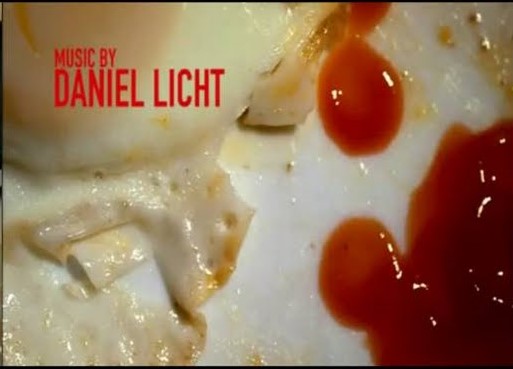
This fifth frame shows an extreme close up of Dexter's breakfast, which should appear innocent immediately seems evil when a blood-like liquid enters the shot, which though is only ketchup, still prompts the audience to believe something is not right about Dexter.


6.


In the final frame I'm analysing is a close up of Dexter's face, showing a very sinister look, straight at the camera. This here shows the use of low key lighting to make Dexter seem more dangerous and once again implant the idea that he is not what he seems. The use of the close up here also allows to try and understand the emotion on Dexter's face even better to help us decipher who he is.


BLUE VALENTINE


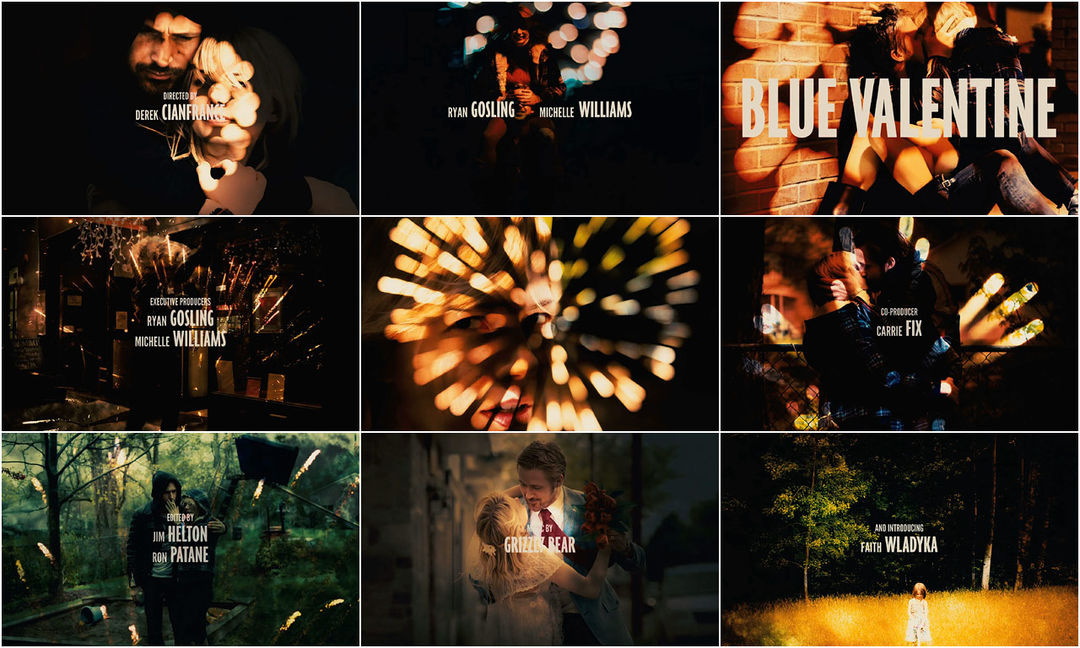
The Blue Valentine title sequence effectively also makes use of contrasting colours and images to get across the nature of the relationship of the two main characters.


1.

This image depicts a couple in close embrace, being surrounded by a wealth of darkness. The picture is also coming to life through a burst of light in the form of a firework. In the photo they seem like a happy couple, yet the black engulfing them could signal there is something darker in their relationship, similar to the dark themes in Dexter.


2.

This second frame has low key lighting, like some of the shots in the Dexter title sequence. this use of such dark lighting could signal that this seemingly happy couple, have had their fair share of unfortunate times. Even the scene that their set in is desolate and depressing, and instead of the fireworks possibly looking uplifting, it tends to add to the destructive look of the shot.


3.

This shot is a lot happier and makes use of much brighter lighting. The image is quite wide to encapsulate the state of joy in the photo. The sepia filter on the photos suggests that the pictures are old and were taken in the past, suggesting that this gleeful state that their in in this frame may not be the state of their relationship in the present.


4.

This fourth frame once again shows a firework erupting onto a photo, but what is being displayed in this photo is not clear. It is a close up of Michelle Williams, but her face emotion is not apparent. She does not seem, happy, or sad, rather indifferent, which is not particularly positive for a relationship. This lets the audience know once again, as in Dexter, not all is well with the protagonists.


5.

By this part of the title sequence we are familiar with the repetitive nature of a firework exploding onto a past picture of the couple, followed by a pitch black screen. This repeating effect could mirror the couple that we are observing's relationship, with the brief fireworks, beaming light onto pleasant times in their relationship. Yet since a majority of the title sequence us spent on a black screen, that would suggest that the majority of their relationship involved them enduring dark times. The explosive nature of the fireworks could even signify fights or arguments that they repeatedly engaged in.


6.

The last frame I will analyse is the last photo the erupts from firework is one of a girl standing alone in a field. The use of a wide shot here is to empahsise the girl's loneliness and let the viewers understand she has no one helping or guiding her. This image can be taken a number of ways: one could think it was the female in the relationship in the past, others could believe it to be the child of the couple. I rather agree, with the latter as it suggests to audiences that her parents, who from the title sequence, we could guess did not have the greatest marriage, have become so distant (to each other) that she now feels suck in the middle, and forsaken.

Saturday, 12 September 2015

Conventions of the Thriller

LOW KEY LIGHTING


Dark lighting in scenes is essential in setting the genre and tone in a thriller. It also contributes to the mystery of the film. 

MYSTERY/ENIGMA


Mystery instills a sense of suspense in the viewers giving them continued interest in the movie, by keeping them asking questions.

SUSPENSE


Suspense is a factor that is compulsory for thrillers. It ensures the audience have intrigue in the film. Suspense is usually created from the mystery involved in thrillers.

SLOW/REALISTIC BUILD UP

The build up in thriller films makes sure the plot points of the aren't revealed too early in the movie and keep the viewers wanting more.

ISOLATED SETTINGS

Giving the film a setting that is secluded and desolate increases the mystery factor of it due to the area being lesser known and away from other parts of the world.

ACTION (sometimes)

Though it's not mandatory, some thriller films make use of action sequences in order to make it more flashy and exciting to watch.

DIEGETIC SOUND OF BREATHING

Diegetic sounds of breathing, especially when the source of the breathing is unknown, is very common in thrillers. It is a convention that, though, is not ubiquitous, is very effective in giving the atmosphere more tension.